ArtOfficial Intelligence
Naoko Yanagida for ROAM.EDITIONS 柳田直子、小坂市、日本
Osaka, Japan
For centuries, art collecting revolved around objects that could be seen, possessed, and preserved. Paintings hung on walls, sculptures occupied pedestals, and decorative arts filled cabinets and salons. Yet the history of collecting is also the history of expanding definitions. What counts as an art object today is vastly different from what it was a century ago.
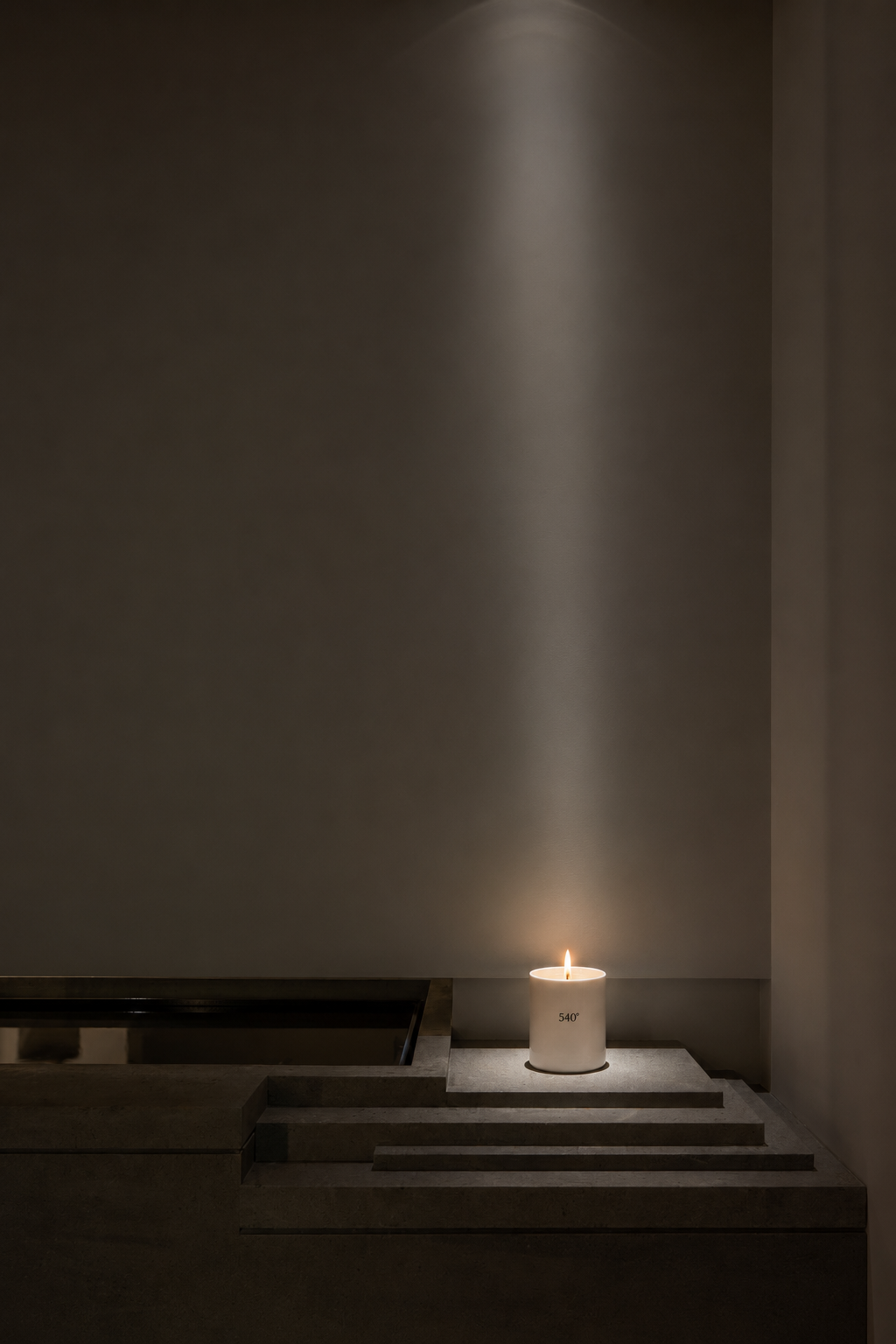
As artistic boundaries have shifted, so too has the nature of collecting itself. Increasingly, the focus is not merely on acquiring objects, but on acquiring experiences. Within this context, the emergence of the 540° artisanal candle as a collectible Atmospheric Object represents a fascinating development.
At first glance, an artisanal candle appears to belong to the realm of decoration or utility. It is designed to be lit, consumed, and eventually replaced. Unlike a painting, it is not expected to endure. Yet the significance of the 540° Atmospheric Object lies precisely in its departure from traditional notions of the collectible object.
Its purpose is not simply to exist within a space, but to transform that space.
The value of the 540° Atmospheric Object resides in its capacity to shape atmosphere. Through fragrance, light, and ritual, it alters the perception of an interior. Rooms acquire a distinct character. Memories become associated with a particular scent. The object becomes a medium through which an environment is experienced rather than merely observed.
This marks a subtle but profound shift. Traditionally, collectors acquired objects that occupied space. The Atmospheric Object acquires space itself.
The 540° artisanal candle belongs to a broader cultural movement in which ambiance has become an aesthetic category. Contemporary interiors are curated through sensory layers of light, scent, texture, and mood. Atmosphere has become something that can be designed, refined, and increasingly collected.
In this sense, the 540° Olfactive Object shares affinities with contemporary art. The artwork is no longer necessarily what one sees. It is the experience one inhabits. The 540° Atmospheric Object operates according to a similar logic. Its physical form is not the ultimate destination of attention. It is the mechanism through which an atmosphere is produced. The true work exists in the encounter between scent, space, memory, and presence.
This also introduces a paradox that distinguishes the Atmospheric Object from traditional collectibles.
Unlike a painting, whose preservation secures its value, the Atmospheric Object 540° fulfills its purpose only through its own consumption. The collector must choose between conserving the object and activating the artwork.
Most collected artworks derive their significance from longevity. The 540° artisanal candle, by contrast, achieves its fullest expression through disappearance. To light it is to diminish it. To preserve it is to deny its intended function.
The collector of the Atmospheric Object 540° therefore faces a dilemma unknown to the owner of a painting or sculpture. Is the object meant to be conserved, or experienced? Is its value found in its material form, or in the atmosphere it creates?
Perhaps this tension reveals something important about contemporary culture. In an age saturated with images and material possessions, experience increasingly carries greater significance than ownership alone. The most valued objects are often those that generate feeling, memory, and presence.
Viewed through this lens, the 540° artisanal candle is not simply a luxury object. It represents a broader evolution in the tradition of collecting. The collector becomes not merely a custodian of objects, but a curator of atmosphere.
Indeed, one might argue that the 540° Atmospheric Object is not the artwork at all. The atmosphere is the artwork. The artisanal candle is merely its vessel. What is collected is not wax, fragrance, or flame, but the possibility of a particular sensory world. In this respect, the 540° Olfactive Object signals a broader transformation in the culture of collecting, from the acquisition of objects to the cultivation of experiences, from possession to presence, and from material permanence to ephemeral meaning.
物理的な世界と仮想的な世界という二部構成で、建物の解剖を模索するこのシリーズは、AIが生成するアートを、過去と未来の狭間にあるデジタルメディア、つまり、通常は私たちが留まるのではなく通り抜ける場所である境界空間として捉えている。
言い換えれば、非場所である。
とはいえ、家は決して境界空間とはみなされないだろう。シリーズ全体を通して、境界空間は、不気味な不在感を通して浮かび上がってくる。
"The paradox is, that unlike a painting, whose preservation secures its value, the Atmospheric Object 540° fulfills its purpose only through its own consumption. The collector must choose between conserving the object and activating the artwork."